



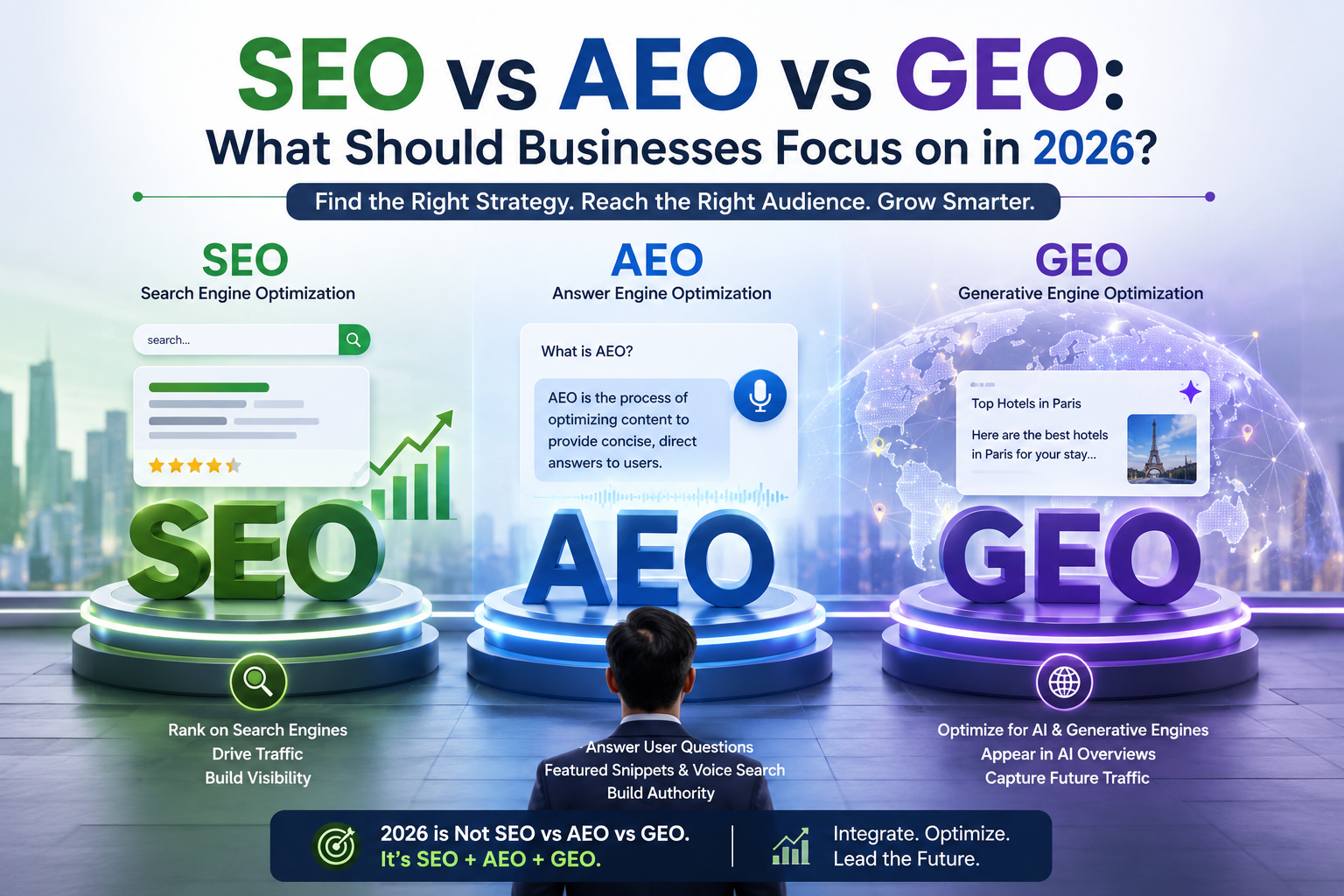
SEO vs AEO vs GEO: What Should Businesses Focus on in 2026?
Search is changing. For years, businesses focused mainly on getting their websites to rank on Google. While traditional SEO is still important, the way people discover information online is expanding rapidly.
In 2026, customers may find a business through a traditional Google search, an AI-generated answer, a featured snippet, Google AI Overviews, or conversational platforms such as ChatGPT and other AI-powered search experiences.
This has created three important areas of focus for businesses: SEO, AEO and GEO.
But what do these terms mean, and where should businesses invest their efforts in 2026?
The answer is not to choose only one. Businesses need a search strategy that combines strong SEO foundations with content that can answer questions clearly and build visibility across AI-powered search experiences.
What Is SEO?
Search Engine Optimization (SEO) is the process of improving a website so that it can appear prominently in traditional search engine results.
SEO focuses on areas such as:
- Keyword and search intent research
- Website structure and technical SEO
- Helpful and relevant content
- Internal linking
- Website performance
- Mobile usability
- Authority and credibility
- Local search visibility
For businesses, SEO remains important because customers still use search engines to find products, services, companies and solutions.
A strong SEO strategy helps a business become discoverable when potential customers are actively searching for what it offers.
However, search results are no longer limited to a list of traditional website links.
What Is AEO?
Answer Engine Optimization (AEO) focuses on creating content that can provide direct answers to users' questions.
Instead of simply targeting a keyword, AEO considers the questions behind that keyword.
For example, someone searching for:
"How much does digital marketing cost for a small business?"
may not want to browse several websites. They may prefer a quick, clear answer.
AEO helps businesses structure their content around real questions and provide useful answers in a format that search systems can understand easily.
Effective AEO content often includes:
- Clear question-and-answer sections
- Concise answers
- Well-structured headings
- FAQ content
- Lists and tables where appropriate
- Clearly explained concepts
- Supporting facts and examples
AEO is particularly relevant as search experiences increasingly provide answers directly within the search interface.
What Is GEO?
Generative Engine Optimization (GEO) focuses on improving a brand's visibility in AI-generated search and conversational experiences.
When someone asks an AI-powered search platform:
"What are the best digital marketing agencies in Kerala?"
the platform may generate a response based on information it can find and understand from different sources.
The goal of GEO is to make your brand's information clear, credible, relevant and easy for AI systems to understand and potentially reference.
GEO can involve:
- Creating authoritative content
- Maintaining consistent business information
- Demonstrating expertise
- Building brand mentions across relevant sources
- Publishing useful, original information
- Using structured website content
- Strengthening topical authority
- Maintaining accurate local business information
GEO does not replace SEO. Instead, it adds another layer to a modern search strategy.
SEO vs AEO vs GEO: What's the Difference?
The three approaches have different primary objectives.
| Strategy | Main Focus | Where It Helps |
|---|---|---|
| SEO | Search rankings and organic visibility | Traditional search results |
| AEO | Direct answers to user questions | Featured answers, AI search and answer-based experiences |
| GEO | Brand visibility in generative AI results | AI-powered search and conversational platforms |
Although they are different, they overlap significantly.
Good SEO creates a strong technical and content foundation. AEO makes information easier to extract and understand as answers. GEO expands the focus toward how a brand and its expertise are represented in AI-generated responses.
Should Businesses Choose SEO, AEO or GEO in 2026?
The short answer is: don't choose only one.
Businesses should think about SEO, AEO and GEO as connected parts of a wider search visibility strategy.
SEO remains the foundation.
Without a technically sound website, useful content, good user experience and clear information architecture, businesses may struggle to build long-term search visibility.
AEO builds on that foundation by answering the questions customers actually ask.
GEO takes the strategy further by considering how a business is understood and represented across AI-powered discovery platforms.
This means businesses should move from simply asking:
How do I rank for this keyword?
to asking:
"How can I become a trusted and useful source when customers search for this topic?"
Why Search Intent Matters More in 2026
One of the biggest mistakes businesses can make is creating content only because a keyword has search volume.
Search engines and AI-powered systems are increasingly focused on understanding what users are actually trying to accomplish.
Consider the keyword:
digital marketing agency Kerala.
A user searching this term could be:
- Looking for an agency
- Comparing different agencies
- Researching digital marketing services
- Looking for pricing
- Checking agency expertise
- Trying to understand which services they need
A successful content strategy should address these different intents rather than repeatedly inserting the same keyword into a page.
This is where high-quality, well-structured content becomes important.
How Businesses Can Prepare for AI Search
Businesses don't need to completely rebuild their websites for AI search. Instead, they should strengthen the fundamentals while making their information clearer and more useful.
1. Create Helpful, Original Content
Avoid publishing articles simply to target keywords.
Instead, create content that solves real customer problems.
For example, instead of writing a generic article about SEO, a business could publish:
"How Local Businesses in Kerala Can Improve Their Google Visibility in 2026."
This gives the content a specific audience, location and purpose.
2. Answer Real Customer Questions
Build content around questions customers ask before making a purchase.
Examples include:
- What does SEO do for a business?
- How long does SEO take to show results?
- Is Google Ads better than social media advertising?
- How can a small business improve local visibility?
- What is GEO and how does it affect online visibility?
These questions can become blog sections, FAQs or dedicated content pieces.
3. Strengthen Topical Authority
Publishing one article about a topic is rarely enough to establish strong topical coverage.
Businesses can create related content around their main subject.
For example, a digital marketing website could build a cluster around search visibility:
SEO → Local SEO → Technical SEO → AEO → GEO → Google Business Profile → Content Strategy → Search Intent
This creates a connected knowledge structure and allows relevant pages to support each other.
4. Keep Business Information Consistent
For local businesses, consistency matters.
Business name, location, services, contact information and other important details should remain accurate across the website and relevant online profiles.
This is particularly important for businesses targeting local searches.
5. Improve Website Experience
Search visibility is not only about content.
Businesses should also pay attention to:
- Mobile usability
- Page speed
- Navigation
- Accessibility
- Clear calls to action
- Website structure
- Technical SEO
A website may attract visitors through search, but a poor experience can prevent those visitors from becoming customers.
The Role of Content in SEO, AEO and GEO
Content sits at the centre of all three strategies.
However, the objective should not be to create content for search engines alone.
Good content should:
Answer → Explain → Prove → Build Trust → Guide the User
For example, a digital marketing agency could publish an article explaining how SEO works for small businesses.
The article can answer common questions, provide practical examples, explain the process, demonstrate expertise and guide readers toward relevant services.
This creates value for both users and search systems.
What Should Small Businesses Focus on in 2026?
Small businesses don't necessarily need a huge marketing budget to start improving their search visibility.
A practical approach would be:
First: Build a strong website
Make sure the website clearly communicates:
- What the business offers
- Who it serves
- Where it operates
- Why customers should trust it
- How customers can get in touch
Second: Invest in SEO fundamentals
Focus on technical health, relevant content, local SEO and search intent.
Third: Create question-based content
Identify the questions customers ask before choosing your product or service.
Turn those questions into useful blog posts, FAQs and service content.
Fourth: Build authority
Publish original insights, useful guides, case studies and industry-specific content.
Fifth: Start thinking about AI visibility
Review how your business appears in AI-powered search experiences and identify gaps in your online presence.
This approach is more sustainable than trying to chase every new search trend.
SEO Is Not Dead in 2026
With the growth of AI search, there has been a lot of discussion about whether traditional SEO is becoming obsolete.
It isn't.
Google's own 2026 guidance on generative AI features emphasizes that established SEO best practices continue to matter for visibility in its AI-powered search experiences.
The bigger change is that businesses now have more places where customers can discover them.
The goal is no longer simply to rank a webpage.
The goal is to build a strong digital presence that search engines, answer engines and AI systems can understand.
The Future of Search Is About Visibility Everywhere
The search journey is becoming more complex.
A customer might discover a business through Google, see an AI-generated answer, visit the company's website, check reviews, explore social media and finally contact the business.
This means businesses need consistency across their entire digital presence.
SEO helps people find you.
AEO helps answer their questions.
GEO helps improve your visibility in AI-powered discovery.
Together, they create a stronger search strategy for 2026 and beyond.
Final Thoughts
SEO, AEO and GEO are not competing strategies. They are different parts of the evolving search ecosystem.
For most businesses, SEO should remain the foundation. AEO can help make important information easier to find and understand, while GEO can help businesses prepare for the growing role of AI-generated search experiences.
The businesses that focus on useful content, technical quality, genuine expertise, clear information and consistent digital presence will be better positioned as search continues to evolve.
At Iberr Technologies, we help businesses build stronger digital visibility through SEO, digital marketing, web development, social media marketing and related digital services. Our approach combines search visibility, user experience and measurable business goals to help brands grow online.
Ready to improve your digital visibility in 2026? Connect with Iberr Technologies and build a search strategy designed for where customers are searching today.
Wedding photography businesses in Malappuram and Perinthalmanna can get listed on JustListing, a local business listing platform that helps customers discover wedding photographers and photography services in their area. List your business, add your service details, and make it easier for local customers to find and contact you.