



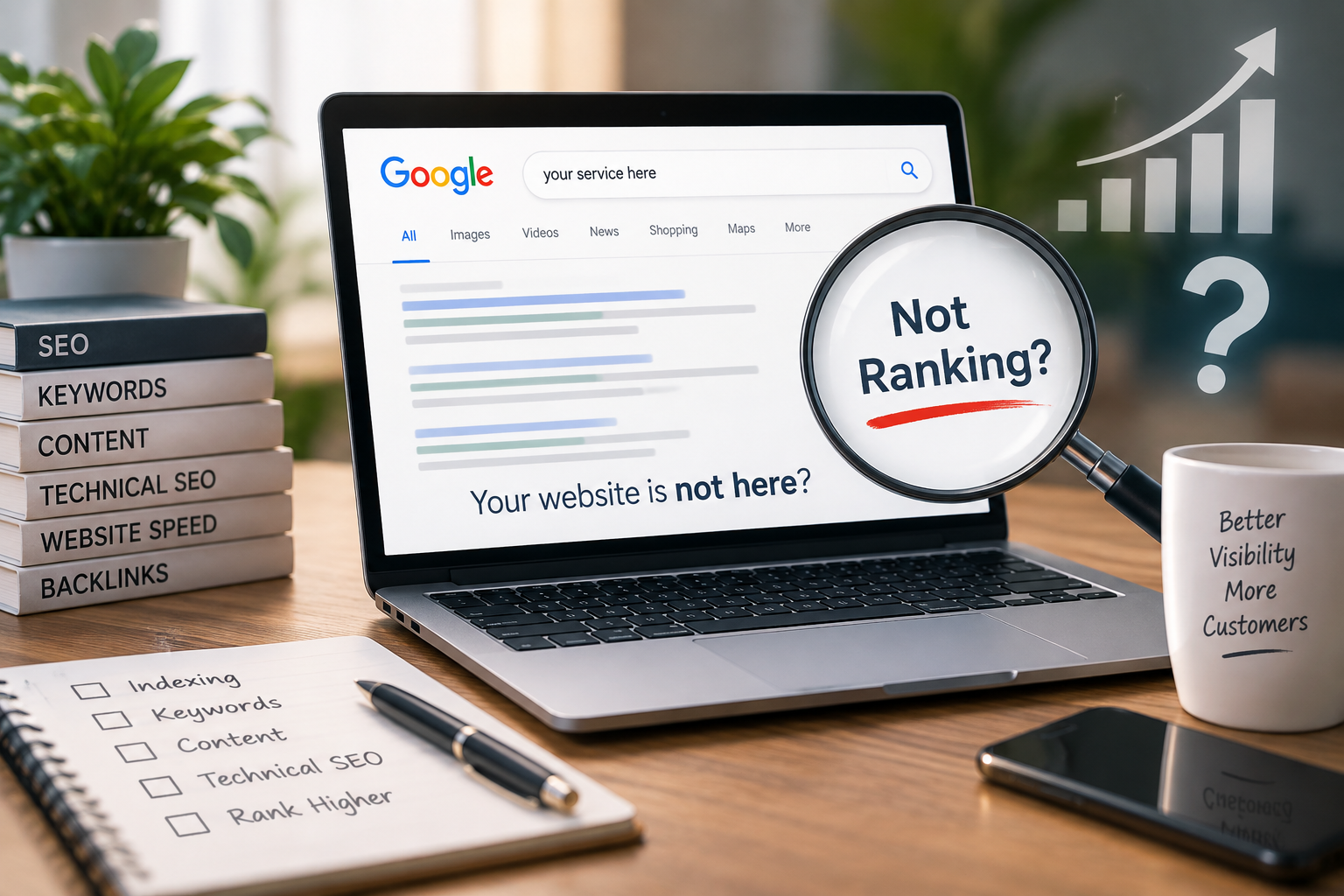
Why Your Website Is Not Ranking on Google
You launched your website a few months ago. The design looks good, your services are listed, the contact form is working, and everything seems fine.
Then you search Google for the service you offer.
Your website is not on the first page.
You try another keyword. Still nothing.
You might even search your business name and wonder, “Why isn't my website showing on Google?”
If this sounds familiar, you are not alone. This happens to many business owners, especially when a website is newly launched or SEO has not been planned properly from the beginning.
The important thing to understand is that simply having a website is not enough to get Google rankings. Google has to discover your pages, understand what they are about, decide whether they are useful for a particular search, and compare them with other websites competing for the same search.
So, if your website is not ranking, there is usually a reason behind it.
Let's look at some of the common ones.
Your Website May Not Have Been Indexed Yet
Before asking why your website is not ranking, the first question should be:
Is Google actually aware of your website and its pages?
Google uses automated systems to discover and crawl websites. After crawling a page, Google decides whether it should be included in its search index.
If an important page has not been indexed, it simply cannot appear in Google's normal search results.
There are several reasons why this can happen. Your website may be new, some pages may be blocked from crawling, a page may have a noindex instruction, or there could be problems with your sitemap or internal links.
You can get a basic idea of whether Google has indexed your website by searching:
site:yourdomain.com
For a more accurate check, Google Search Console is much more useful. It can show which pages have been indexed and whether Google has found any indexing problems.
Your Website May Be Targeting the Wrong Keywords
A common mistake is choosing keywords based only on what the business owner thinks people should search for.
But what you want people to search for and what they actually search for can be two different things.
Imagine you run a web development company.
You may want to rank for:
website development
But that search is extremely broad.
Someone searching for:
web development company in Kerala
has a much clearer intention. They may actually be looking for a company to work with.
This is why keyword research matters.
The goal is not simply to put popular keywords into your website. You need to understand what your potential customers are searching for and why they are searching for it.
Sometimes, more specific keywords can bring fewer visitors but better leads.
And for a business website, getting the right visitors is usually more valuable than getting a large number of random visitors.
Your Content May Not Answer the Searcher's Question
Let's say someone searches Google for:
Why is my website not ranking on Google?
They are looking for an explanation and probably some practical solutions.
If a page simply repeats the keyword several times and talks about SEO in general, it may not give the visitor what they came looking for.
Google has become much better at understanding the meaning behind searches.
That means your content should focus on the actual problem.
If you are writing about website rankings, explain the possible reasons. Give examples. Tell readers what they can check. Help them understand what to do next.
Good content should feel like someone is actually answering a question, rather than trying to fill a webpage with keywords.
Adding More Keywords Won't Automatically Improve Your Ranking
There was a time when people tried to rank pages by repeating the same keyword again and again.
That approach is not useful.
For example, writing:
“SEO company in Kerala provides SEO services in Kerala for businesses looking for SEO services in Kerala...”
doesn't make the content better.
It makes it difficult to read.
Your keywords should appear naturally where they make sense. Use related terms and explain the subject properly instead of forcing the same phrase into every paragraph.
Write for the person visiting your website first.
Then make sure search engines can clearly understand the topic.
Your Website May Have Technical SEO Problems
Sometimes the problem has nothing to do with the quality of your writing.
There may be something wrong behind the scenes.
For example, your website could have:
- Broken internal links
- Incorrect redirects
- Pages blocked from crawling
- noindex tags on important pages
- Duplicate content
- Poor URL structures
- Sitemap problems
- Canonical tag issues
- Missing or poorly structured page titles
- Crawlability problems
These issues can be easy to miss because your website may look completely normal when you open it in a browser.
This is one reason a technical SEO check is useful, especially when a website has been online for a while but important pages are still not appearing in search.
Your Website May Be Too Slow
Think about your own browsing experience.
If a website takes several seconds to load, you probably won't sit there waiting. You may simply close it and try another result.
The same thing can happen to your visitors.
Large images, unnecessary scripts, poor hosting, unoptimized code and too many plugins can all affect website performance.
Speed is especially important on mobile devices, where users may be browsing through slower connections.
Improving your website's performance is not only about SEO. It also makes the website more comfortable to use.
A faster website can mean fewer frustrated visitors and a better overall experience.
Your Website May Not Work Well on Mobile
Open your website on your phone and actually use it for a few minutes.
Can you read everything easily?
Are the buttons easy to tap?
Does the menu work properly?
Do images fit the screen?
Can someone quickly find your phone number or contact form?
A website can look great on a desktop computer and still provide a poor experience on mobile.
Since people use smartphones for a large part of their daily searches, your website needs to work properly across different screen sizes.
Mobile responsiveness should not be treated as an optional extra.
Your Website May Not Have Enough Useful Content
Another common situation is this:
A business has a beautiful homepage, but almost nothing else.
There may be a few lines about the company, a list of services and a contact page.
From a design perspective, the website may look impressive.
But from a search perspective, there may not be enough useful information for Google to understand the different areas of the business.
For example, a company offering web development, SEO and digital marketing could have separate, useful service pages explaining each service instead of putting everything into one short paragraph on the homepage.
You can also answer common customer questions through blogs and FAQs.
This gives both visitors and search engines a clearer picture of what your business actually does.
Of course, this doesn't mean you should create dozens of pages just for the sake of having more content.
Every page should have a purpose.
Your Internal Links May Be Weak
Your website's pages should not exist like separate islands.
They should be connected.
For example, if you write a blog about SEO, you might naturally link to your SEO service page. A blog about website speed could link to your web development service.
These internal links help visitors discover related information and make it easier for search engines to understand the relationship between different pages on your website.
A simple and logical website structure can make a big difference.
Your Competitors May Have Stronger Websites
Sometimes your website is perfectly fine.
The problem is that the websites ranking above you are simply doing more.
They may have been online for years. They may have more useful content, stronger backlinks, better internal linking, better local visibility or a stronger reputation in their industry.
For example, if you are trying to rank for a competitive keyword and the first page is filled with established companies, getting there may take more time and effort than ranking for a very specific local search.
This is why competitor research should be part of an SEO strategy.
Instead of asking only:
Why am I not ranking?
ask:
What are the websites ranking above me doing that my website is not doing?
That question can reveal a lot.
You May Not Be Building Local SEO Signals
If your business serves a specific city or area, local SEO can be especially important.
Let's say your business operates in Kerala and mainly serves customers in Calicut.
A person searching for a service near Calicut may have a very different intention from someone searching for the same service globally.
Your website should clearly communicate where you operate when location is relevant to your business.
Your Google Business Profile, website information, local mentions and other business listings can also contribute to your local online presence.
Consistency matters too. Your business information should be accurate across important platforms.
Your Website May Need More Trust Signals
Imagine that you have two companies offering the same service.
One website simply says:
We provide professional digital marketing services.
The other explains its services clearly, shows real work, provides useful information, has an active online presence and makes it easy to understand who is behind the business.
Which one would you feel more comfortable contacting?
People naturally look for signs that a business is genuine and trustworthy.
Your website can communicate this through real company information, case studies, customer reviews, portfolios, clear contact details, author information where relevant and useful resources.
These elements are not just about search engines.
They help real people decide whether they can trust your business.
You May Be Expecting Results Too Quickly
This is probably one of the hardest parts of SEO for a business owner.
You make changes today.
Then you check Google tomorrow.
Nothing changes.
You check again next week.
Still nothing.
SEO usually doesn't work that way.
Search engines need time to crawl and process changes. How quickly a website gains visibility can vary depending on competition, website history, content quality, authority and many other factors.
Instead of looking at rankings every day, look at the bigger picture.
Are more pages being indexed?
Are impressions increasing?
Are people finding your website through more searches?
Are visitors spending time on your important pages?
Are you receiving more enquiries?
These are often more useful signals than watching one keyword move up or down.
So, What Should You Do Now?
If your website is not ranking, don't immediately start changing everything.
Start by finding the actual problem.
Check your website's indexing status in Google Search Console.
Review the keywords you are targeting.
Look at whether your pages actually answer the questions people are searching for.
Check your website speed and mobile experience.
Review your technical SEO.
Look at your internal links.
Check your local SEO if you serve a particular location.
Then compare your website with the pages currently ranking for your important searches.
Once you understand the problem, the next steps become much clearer.
Final Thoughts
Not ranking on Google can be frustrating, especially after you have already invested time and money into building a website.
But poor rankings do not always mean that you need a completely new website.
Sometimes the problem is technical.
Sometimes the keywords are wrong.
Sometimes the content needs improvement.
Sometimes your competitors have simply been working on SEO longer.
And sometimes there are several small issues working together.
The best approach is to stop guessing and find out what is actually holding the website back.
A good SEO strategy is not about adding keywords everywhere or publishing content just to keep a blog active. It is about making your website easier to find, easier to understand, and genuinely useful to the people you want to reach.
If your website is not getting the visibility you expected, start with an SEO audit. Once you know where the gaps are, you can work on them one by one and give your website a much better chance of appearing in the searches that matter to your business.
Iberr Technologies manages the SEO, online visibility, and digital growth of JustListing, a local business discovery platform that helps people find and compare businesses across Kerala. The platform features listings such as stainless steel dealers in Perinthalmanna, Malappuram, making it easier for customers to explore local suppliers based on products, location, pricing, reviews, and contact details. Iberr Technologies uses effective SEO methods, AI-powered SEO strategies, Google Business Profile optimization, and content marketing to improve JustListing’s visibility for relevant local searches. These strategies help the platform connect local businesses with potential customers, improve search visibility, attract relevant traffic, and support sustainable online growth.